The Transparent Process Behind Durable Metalwork
Why Understanding Materials Is Your Foundation for Success
Before you dive into any custom metal project, you need to understand what you’re actually working with. Metal fabrication isn’t about grabbing whatever steel is lying around and hoping for the best. Each metal brings specific properties to the table, and choosing the right one determines whether your project lasts five years or fifty.
Steel remains the workhorse of most fabrication projects because it offers an unbeatable combination of strength, weldability, and cost-effectiveness. Mild steel works beautifully for structural applications like gates, fences, and handrails. It welds cleanly, accepts paint and powder coating well, and handles the load-bearing demands of everything from farm equipment repairs to custom fabrication projects. In Southern Middle Tennessee and North Alabama, where summer humidity can top 80% for weeks at a time, proper surface preparation and coating on mild steel prevents the rust that would otherwise eat through unprotected metal in just a few seasons.
Aluminum steps in when weight matters or corrosion resistance is non-negotiable. It costs more upfront, but for applications like awning frames, decorative panels, or anywhere you need the metal to stay bright without constant maintenance, aluminum delivers. It requires different welding techniques (TIG welding for aluminum produces the cleanest, strongest joints), and you can’t just swap your steel settings and expect good results.
Stainless steel occupies the premium tier. It resists corrosion naturally, maintains its appearance with minimal care, and works perfectly for food-service equipment, high-visibility railings, or anywhere aesthetics and durability must coexist. The tradeoff? It’s harder to machine, more expensive to purchase, and demands more skill to weld properly.
Here’s what most people miss: material selection isn’t just about the metal itself. It’s about understanding how that metal will perform in your specific environment and application. A custom gate that works perfectly in Arizona might fail in Lincoln County, Tennessee, where freeze-thaw cycles, spring storms, and summer heat all take their toll. When you’re planning a project, think about what the metal will face over its lifetime, not just what looks good on installation day.
How Proper Planning Transforms Vague Ideas Into Precise Specifications
The gap between “I want a custom gate” and a finished product you’ll love for decades lives entirely in the planning phase. This is where most projects either set themselves up for success or stumble into expensive revisions and disappointment.
Start with the actual purpose. Are you building a decorative entry gate that needs to impress visitors, or a functional farm gate that will swing open five times a day for the next twenty years? The answer changes everything: material thickness, hinge selection, latch mechanisms, and even the welding approach. A residential decorative gate might use lighter-gauge steel with ornamental scrollwork, while an agricultural gate needs heavier structural tubing and hinges rated for constant use.
Dimensions matter more than most people realize. Measure twice, cut once isn’t just a saying; it’s how you avoid ordering material that’s six inches too short or building a gate that binds against the frame every time you try to close it. When working with existing structures (adding a handrail to existing stairs, for example), even a quarter-inch measurement error multiplies across the length of the project. During the humid months here in Middle Tennessee, metal can expand slightly, and while the change is minimal, accounting for thermal movement in your design prevents binding and premature wear.
Structural requirements can’t be guessed. Building codes exist for good reason, especially for railings, staircases, and load-bearing supports. Handrail height, baluster spacing, and load ratings are all specified to keep people safe. A qualified welding and fabrication partner knows these requirements cold and designs accordingly from the start, saving you from failing an inspection or, worse, someone getting hurt.
Material selection deserves a second look at this stage. That vision you have of a sleek, modern railing? It might call for stainless steel with a brushed finish. The farm equipment repair sitting in your barn? Structural steel will handle the load and the abuse. Budget matters, but so does longevity. Spending an extra fifteen percent on the right material often means avoiding a total replacement in ten years.
Here’s the real value of working with someone experienced: they ask the questions you didn’t know you needed to answer. What’s the wind exposure? Will this see daily use or occasional use? Do you need it to match existing metalwork? These details shape the final design and determine whether your project performs exactly as you hoped or becomes a source of frustration.
The Equipment and Skills That Separate Professional Work From Amateur Attempts
This is where your design becomes physical reality, and the difference between adequate and exceptional shows up in every cut and every weld. The techniques and equipment used at this stage determine structural integrity, appearance, and how long your project will last under real-world conditions.
CNC plasma cutting has revolutionized custom metal work. Instead of marking and cutting by hand (slow, inconsistent, and limited in complexity), a CNC plasma cutter follows digital files to make precise, repeatable cuts through steel and aluminum. Need twenty identical brackets? They’ll all match perfectly. Want an intricate design cut into a gate panel? The machine handles curves and details that would take hours by hand. The edge quality matters too: a clean plasma cut needs minimal grinding and prep before welding, which means tighter tolerances and better-looking finished joints. When you’re fabricating custom signage, decorative panels, or anything where appearance matters, CNC plasma cutting delivers consistency you simply can’t achieve manually.
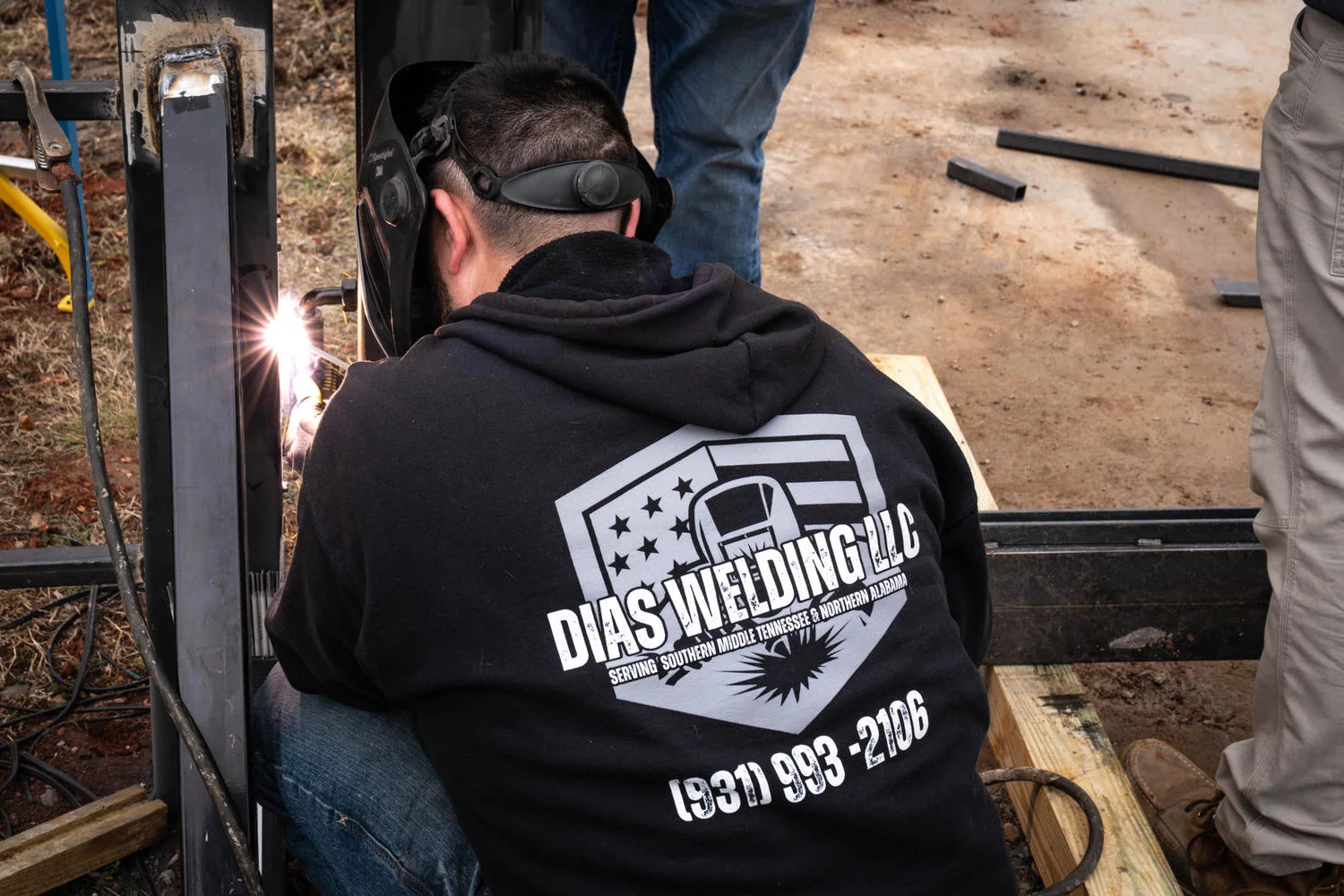
Welding technique makes or breaks structural integrity. MIG welding (Metal Inert Gas) is the go-to for most steel fabrication because it’s fast, versatile, and produces strong welds on mild steel and stainless. It works beautifully for structural applications like handrails, gates, and equipment repairs where strength matters more than absolute aesthetic perfection. TIG welding (Tungsten Inert Gas) steps in when you need precision and a clean appearance. Aluminum welding demands TIG for reliable results, and any visible weld on stainless steel or decorative ironwork benefits from TIG’s precise, spatter-free finish.
Here’s what actually happens during a quality welding process: proper joint preparation (cleaning, fit-up, sometimes beveling for thicker materials), correct machine settings for the material and thickness, consistent travel speed and technique, and inspection after each pass. A skilled welder reads the puddle, adjusts in real time, and produces welds that penetrate fully without burning through. When you’re repairing farm equipment that will bear thousands of pounds or building a staircase that needs to support people safely, weld quality isn’t negotiable.
Bending and forming add another dimension. Sometimes your design calls for curved railings, rolled tube, or formed brackets. Proper bending equipment prevents kinking, maintains wall thickness, and creates smooth curves that look intentional, not improvised. In North Alabama, where ornamental ironwork remains popular for entries and porches, the ability to form graceful curves separates basic fabrication from true craftsmanship.
The environmental reality here matters during this phase too. Summer heat in a non-climate-controlled shop can affect welding gas flow and metal temperature. A fabricator who understands these variables adjusts technique accordingly, ensuring consistent quality regardless of whether it’s July or January.
Why the Final Steps Determine Whether Your Project Looks Good or Looks Professional
You’ve got precision-cut components and solid welds. Now comes the phase that determines whether your project looks like professional work or a backyard experiment: assembly, finishing, and quality control.
Fit-up and final assembly require patience and precision. Every component should align correctly, gaps should be consistent, and the whole assembly should be square, plumb, and level. For a custom gate, that means the frame is perfectly square so the gate hangs straight and swings smoothly. For handrails, it means every section aligns and all mounting points sit flush against the mounting surface. Rushing this phase creates problems you’ll see every single day: gates that sag, railings that look crooked, and joints that don’t quite meet properly. Quality fabricators use jigs, fixtures, and careful measurement to ensure everything fits correctly before final welding.
Surface preparation separates projects that last from projects that rust out prematurely. Before any coating goes on, the metal needs to be absolutely clean: free of mill scale, welding slag, oils, and oxidation. Grinding, wire brushing, and often chemical cleaning prepare the surface. In the humid climate we deal with in Southern Middle Tennessee, any contamination left under paint or powder coating creates a starting point for corrosion. Within two or three years, you’ll see rust bleeding through and coating failure. Do it right the first time, and your finish lasts decades.
Coating selection depends on the application and exposure. Powder coating provides the most durable finish for outdoor metal work, resisting UV damage, moisture, and physical wear far better than paint. It’s the right choice for gates, railings, and any structural or decorative metalwork exposed to weather. For agricultural equipment and repairs where appearance matters less than function, a quality primer and industrial enamel offers good protection at lower cost. Stainless steel often needs no coating at all; proper finishing and passivation maintain its natural corrosion resistance.
Quality assurance means actually inspecting the finished work before it leaves the shop or gets installed. Check weld quality and penetration. Verify dimensions against the original specifications. Test moving parts (gate latches, hinges, sliding components) for smooth operation. Look for any coating defects, missed spots, or areas that need touch-up. For welding repairs on critical equipment, this might include load testing or non-destructive testing to verify integrity.
Installation is the final quality checkpoint. Proper anchoring, alignment, and attachment ensure the fabricated piece performs as designed. Handrails need to be solidly mounted to handle lateral loads. Gates need properly installed hinges and latches positioned for smooth operation. Even a perfectly fabricated piece fails if the installation is sloppy, so attention to detail carries through to the very end.
Making Your Investment Last Through Decades of Southern Weather and Daily Use
All the planning, cutting, welding, and finishing means nothing if your project doesn’t hold up to the specific conditions it will face here in Southern Middle Tennessee and North Alabama. Understanding real-world applications and maintenance requirements keeps your investment working and looking good for decades.
Environmental factors here are real and relentless. Summer humidity regularly exceeds 75%, creating perfect conditions for surface corrosion on any coating defect or exposed steel. Spring brings temperature swings that cycle metal through expansion and contraction, testing every weld and joint. Winter occasionally delivers ice and freezing rain that loads up gates and railings with extra weight. A fabrication approach that works in Arizona or Colorado needs adaptation here. Proper surface prep, quality coatings, and design details that shed water instead of trapping it make the difference between a gate that looks great at twenty years and one that’s rusting out at five.
Agricultural applications place unique demands on metal fabrication. Farm gates swing dozens of times per day and get bumped by equipment, livestock, and occasionally a distracted driver. Equipment repairs often involve repairing cracks in high-stress areas or replacing worn components on machinery that can’t be down for long during planting or harvest season. The fabrication needs to be strong enough to handle abuse, but also practical to install and maintain. In Lincoln County, where agriculture remains a major part of the economy, understanding farming operations and equipment means understanding what your customers actually need, not just what looks good on paper.
Residential and commercial applications demand a different balance. Custom handrails and railings need to meet building codes while also complementing the architecture. Decorative gates and fencing should enhance curb appeal and property value. Awnings and structural supports must handle wind loads and snow accumulation (yes, we get snow here, and when we do, it can load up horizontal surfaces significantly). The fabrication still requires the same precision and quality, but the success criteria shift toward aesthetics, code compliance, and integration with existing structures.
Maintenance keeps everything working as designed. Even powder-coated steel benefits from occasional washing to remove dirt and pollen that can trap moisture against the surface. Moving parts (hinges, latches, rollers) need periodic lubrication. Inspect for any coating damage and touch up promptly before rust gets a foothold. Stainless steel needs occasional cleaning to maintain its appearance, especially in areas with hard water that leaves mineral deposits. These aren’t complicated tasks, but doing them consistently extends the life of your metalwork dramatically.
When repairs are needed, address them promptly. A small rust spot, a loose bolt, or a bent component only gets worse with time. Catching problems early usually means a simple fix instead of a major repair or replacement. This is where having a relationship with a local fabrication shop pays off. Someone familiar with your project can often repair or modify existing work much more efficiently than starting from scratch.
The bottom line? Metal fabrication done right creates value that lasts. Whether you’re investing in a custom gate for your property, repairing farm equipment that represents tens of thousands of dollars, or adding handrails for safety and accessibility, the process matters. Understanding materials, planning thoroughly, using proper techniques and equipment, finishing correctly, and maintaining consistently means your project delivers exactly what you need for as long as you need it. If you’re ready to move forward with a custom fabrication project or need repairs and modifications on existing metalwork, working with someone who understands both the process and the local conditions ensures you get results you’ll be happy with for years to come.